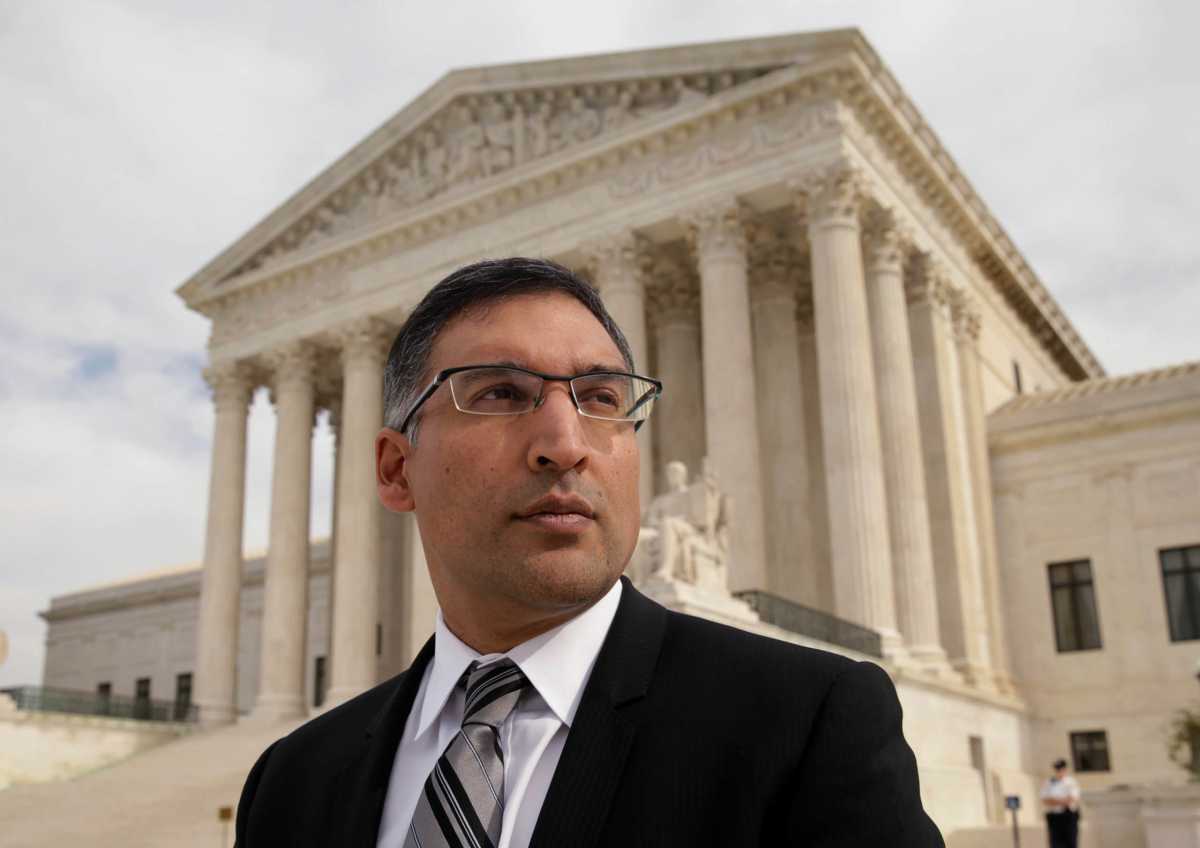
The morning after Election Day, the Supreme Court conducted a telephonic hearing in Fulton v. City of Philadelphia, presenting an opportunity for the reconstituted nine-member high court to rule in a very important LGBTQ civil rights case.
Fulton presents the critical question of whether Catholic Social Services (CSS) can claim a religious exemption from complying with the LGBTQ nondiscrimination requirements Philadelphia imposes on foster care agencies with which the city contracts to carry out the screening of prospective parents.
Review of the arguments made on November 4, however, suggests the ways by which the high court could avoid ruling on the hotly disputed clash between anti-discrimination rules and free exercise of religion. Questions from the justices signaled an interest by many of them — not just the three remaining Democratic appointees —in avoiding any change in the underlying precedent dating back 30 years that allows religiously-neutral laws of general application to be enforced even though they may incidentally burden free exercise of religion.
Justices’ questioning suggests desire to find for foster care agency without establishing breakthrough religious exemption precedent
Newspaper publicity about a religiously-based foster care agency, Bethany, turning away a same-sex couple led the city to investigate the policies of all the foster care operations with which it contracted and to issue ultimatums to the two out of compliance — Bethany and CSS — that they risked losing their contracts. Bethany backed down, but CSS chose to file suit in federal court as the city refused to renew its contract.
CSS argued that Philadelphia’s action violated its free exercise of religion and freedom of speech. The agency maintained that it had never been approached by prospective same-sex foster parents, and that if it were it would refer them to one of the 30 other agencies in Philadelphia, mostly secular, that would be happy to evaluate them. In effect, CSS argued, no same-sex couple would be deprived of the opportunity to become foster parents because of its policy.
Both the federal district court in Philadelphia and a Third Circuit Court of Appeals three-judge panel ruled against CSS, finding that the city has a right to require it to comply with its nondiscrimination policy if it wanted to continue performing what is a governmental function. When the Supreme Court agreed to review the case, it was flooded with amicus briefs arguing both sides of the issue.
Among the questions that CSS asked the court to decide was whether the 1990 Employment Division of Oregon v. Smith precedent should be “reconsidered.” Including this question may be what snagged the interest of at least four justices to review the case, since each of them — Clarence Thomas, Samuel Alito, Neil Gorsuch, and Brett Kavanaugh — have indicated an interest in reconsidering that case. In his partial dissent in the 2018 Masterpiece Cakeshop case involving the Colorado baker who refused to create a wedding cake for a gay couple, Gorsuch had called for reconsideration, calling Employment Division “controversial.”
Ironically, the author of that decision was conservative Justice Antonin Scalia, and at the time the court’s liberal members were the dissenters. Scalia took the position that allowing people to refuse to comply with general laws based on their religious beliefs was a recipe for anarchy. It is one thing to challenge the constitutionality of a law that specifically targets a religious practice, Scalia concluded, but quite another to say that an individual or institution can claim a religious objection to a general law that does not single out any religious practice and is not motivated by anti-religious animus. The 1990 ruling replaced prior precedents holding that a law substantially burdening a religious practice was subject to “strict scrutiny” — meaning it could not be enforced against a religious observer unless the government had a compelling interest achievable only through enforcing it.
Lori Halstead Windham, a lawyer for the Becket Fund for Religious Liberty, a Catholic litigation group, argued that CSS should win regardless of whether Employment Division v. Smith was overruled, because the Philadelphia law at issue was not a law of “general applicability” since it allows foster care agencies to seek exemptions from complying with nondiscrimination requirements. For example, the agencies can take account of religion or race or disability when matching potential foster parents with children in particular cases, she pointed out. This, she contended, sharply undercut the argument of neutrality and general application, making it appropriate for the court to subject the law to a compelling interest test.
Windham also argued that city had no compelling reason to require CSS to evaluate same-sex couples with so many other agencies available to do so.
Excluding CSS from the foster care business in Philadelphia, she contended, was harmful to children in that city by reducing the number of placements that would take place, noting that at any given time the city has custody of several hundred children needing placements.
Windham attacked the law as an unconstitutional regulation of a religious institution, arguing further that requiring CSS to certify same-sex couples as qualified violated its freedom of speech by compelling it to state approval of same-sex couples and their marriages.
Finally, she pointed out that Employment Division v. Smith had proved a difficult precedent to apply consistent with the high court’s expanding view of free exercise of religion and should be abandoned, but she didn’t really press that point very hard.
Hashim Mooppan, an attorney from the US Justice Department’s Solicitor General Office, appeared in support of CSS, reflecting the Trump administration’s posture in favor of maximizing free exercise of religion, but his arguments added little to what Windham had to say. Mooppan’s argument strayed into controversial territory when he contended the city could forbid religious agencies from discriminating based on race, even if their religious beliefs opposed interracial marriages, but could not require them to provide services to same-sex couples. The high court has generally rejected the idea that some anti-discrimination categories addressed in law are weightier than others, but Mooppan insisted it has in the past placed particular emphasis on the constitutional treatment of race discrimination.
Neal Katyal, an acting solicitor general in the Obama administration and experienced Supreme Court litigator, represented the city, arguing that CSS was performing a governmental function through its contract with Philadelphia. He contended that the case was not about regulating private activity or merely licensing agencies, but rather about the city setting reasonable terms for those who sought to perform functions in its name. The children referred to foster care agencies are in the custody of the city, the city is responsible for their welfare, and the city has a right to establish the terms on which it will contract with foster care agencies, he argued.
Along with Jeffrey Fisher, an attorney representing Support Center for Child Advocates and Philadelphia Family Pride, an LGBTQ rights organization — which intervened to defend the city’s policy — Katyal also emphasized that the exemptions Windham relied in arguing that this was not a law of general application were irrelevant because they do not apply at the screening stage of the foster care process. The city would not grant an exemption to allow an agency to categorically exclude people protected under its anti-discrimination law. Instead, exemptions were granted on an individual case basis consistent with the best interest of a specific child, as required by Pennsylvania law.
Unless the court is ready to overrule Employment Division v. Smith, or modify it in some way, that precedent compels the decision reached by the trial court and the court of appeals, Katyal and Fisher argued.
The Supreme Court generally tries to avoid deciding constitutional questions unless it is absolutely necessary to decide a case. Here, if the court wants to avoid the constitutional question and still rule in CSS’ favor — as the conservative majority may want to do — they could use the off-ramp used in the Masterpiece Cakeshop case, avoiding the underlying issue and finding that the government decision-maker was hostile to religion in how it handled this particular matter. CSS pointed to statements and letters from the city as evincing such hostility, and could also point to the City Council’s reaction to the news reports that first raised the issue.
Or, the court could embrace Windham’s characterization of the exemption process and conclude that the existence of exemptions means the law is not generally applied, and so does not fall within the scope of the Employment Division precedent.
Another way out was suggested by Justice Stephen Breyer, who asked whether CSS’ objections could be satisfied by contractually allowing it to express its religious views as part of its evaluation of same-sex couples and disclaim any approval of same-sex marriages. That approach, of course, would certainly undermine the city’s antidiscrimination policy. The reason no same-sex a couple has ever applied to CSS is undoubtedly because they would anticipate being rejected on religious grounds.
The newest member of the Court, Justice Amy Coney Barrett, was closely watched, as many assumed this conservative Catholic would favor CSS’ arguments. Her questioning, however, challenged the positions of both sides and did not suggest any particular predisposition.
Predicting an outcome is difficult, even though there is now a solid conservative court majority of 6-3. The court would seem likely to be eager to find a way to reverse the lower courts and give a victory to CSS, but that does not necessarily mean that it will overrule Employment Division v. Smith. Reverting to the pre-Smith precedents would, as the late Scalia suggested, introduce a wild card into all government contracting, allowing potential contractors with religious objections to any facet of the governing rules to claim a constitutional right to ignore them. It would not be surprising if the court were unwilling to go back down that route.
The court could well decide that Katyal and Fisher’s argument that this issue is about more than simply licensing but instead foster care agencies carrying out a government function does not apply, that the law was not being generally applied, or that the government’s compelling interest in being sure foster parenting options are available to same-sex couples does not compel dropping CSS from the program since it stated it would refer such couples elsewhere.
A decision in the case could come within the next few months, but significant rulings in LGBTQ cases normally take longer to be produced since they typically generate dissenting opinions, drafts of which circulate back and forth among justices over extended periods of time.
To sign up for the Gay City News email newsletter, visit gaycitynews.com/newsletter.